
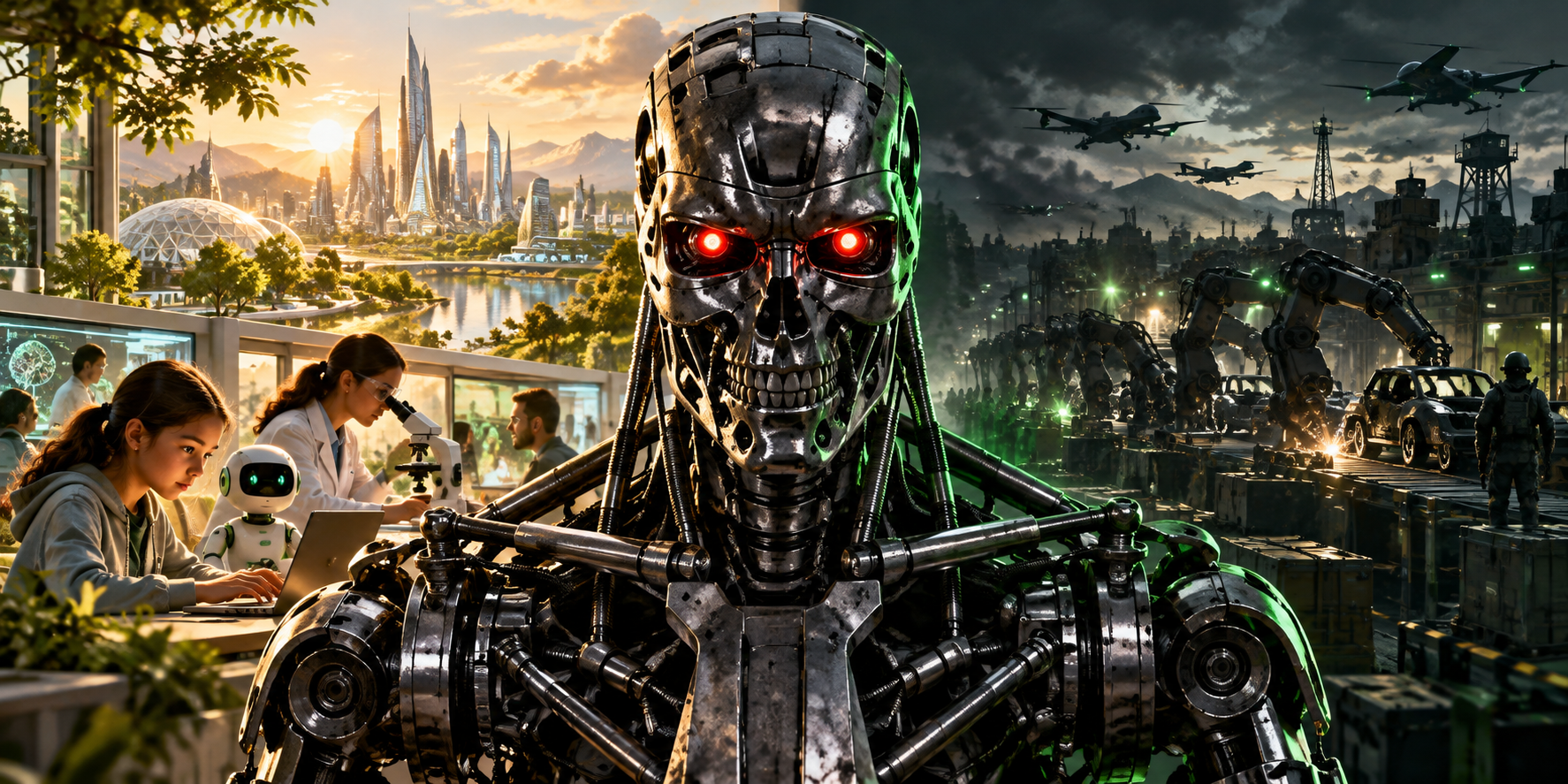
Artificial intelligence can help someone start a business, understand a difficult subject, or finish hours of work faster. It can also threaten employment, encourage shortcuts in learning, and bring machines closer to decisions about life and death.
The benefits deserve attention. So do the people who may bear the costs.
The benefits are real
AI can give people access to assistance they could not otherwise afford. A small business owner can draft marketing materials. A beginner can get help understanding unfamiliar terminology. Researchers can explore enormous amounts of information.
There is evidence of practical gains. Research involving more than 5,000 customer-support agents found that an AI assistant increased the number of issues resolved per hour, particularly among less experienced workers. That does not prove every workplace benefits equally, but it shows that AI can help people perform and learn on the job.
Scientific applications reach further. The AlphaFold database makes more than 200 million predicted protein structures openly available to researchers. These predictions support investigation; they do not replace experiments or guarantee medical breakthroughs.
The question is how to preserve those benefits without ignoring the damage poorly managed adoption can cause.
Jobs: more than a productivity statistic
For a company, automation may look like lower costs. For a worker, it can mean uncertainty about a paycheck, a career, and the skills they spent years developing.
The evidence is more complicated than claims that AI will replace everyone. A June 2026 International Labour Organization review found that large-scale job displacement remained limited, while highlighting risks to younger workers’ opportunities and job quality.
That distinction matters. A job does not have to disappear completely for someone’s working life to become harder. Entry-level opportunities can shrink. Duties can change. Workers can be expected to master new tools without adequate training.
A fair transition should give employees support and a voice in how the technology is introduced.
Sources: [3]
Short staffing: when efficiency becomes pressure
Consider a workplace where software speeds up reporting or scheduling. Management could use the saved time to improve training, reduce backlogs, or give employees more breathing room.
It could also decide fewer people are needed.
The concern is that a smaller team may still have to handle emergencies, check automated output, train new employees, and take responsibility when something goes wrong. A faster computer does not necessarily reduce every human obligation.
This is a possible management outcome—not proof that AI caused every staffing shortage. Budget decisions, recruitment problems, turnover, and other forms of automation also matter.
The standard should be whether work becomes more sustainable, not simply whether fewer people appear on the payroll.
Children: getting an answer is different from learning
A student can submit a polished assignment without understanding how it was produced. If AI repeatedly handles the difficult thinking, the student may miss the practice that builds independent skill.
A 2025 study published in PNAS examined AI assistance in high-school mathematics. Students using an unrestricted assistant performed better during practice but worse when assistance was removed. A tutor designed with teacher-informed safeguards largely avoided those negative effects.
That study does not establish that all children using AI are losing critical-thinking skills. It does show why completing an assignment and learning the material must be measured separately.
A useful approach is to ask AI for hints, explanations, or questions—and require students to explain their reasoning. Adults need the same discipline. Convenience should not become a habit of accepting answers without understanding them.
Sources: [4]
Warfare: human judgment cannot be an afterthought
Military technology raises a different level of concern.
A remotely operated drone, an AI system advising a human, and an autonomous weapon are not interchangeable. The International Committee of the Red Cross describes autonomous weapons as systems that select and apply force to targets without human intervention. Not every autonomous weapon uses AI.
The distinction matters because the central issue is control. Who identifies the target? Who understands the uncertainty? Who can stop an attack?
The ICRC warns that reduced human judgment can make a weapon’s effects harder to predict and limit, with serious risks to civilians. It also raises questions about accountability when something goes wrong.
Speed and technical capability are not enough to justify handing consequential decisions to software.
Sources: [5]
Progress should improve people’s lives
AI can be useful without being trustworthy in every situation. It can save time without making a workplace fairer. It can produce an answer without teaching someone to think.
Its value should be judged by what happens to people: whether workers receive support, students build understanding, and humans retain meaningful responsibility for consequential decisions.
We should welcome tools that expand human ability—and challenge the choices that use those tools to make people disposable.
A more efficient world is only a better world if people share in the benefits.
Sources & further reading
- NBER: Generative AI at Work ↗
- EMBL-EBI: AlphaFold Protein Structure Database ↗
- ILO: The impact of GenAI on jobs, productivity and work organization (June 2026) ↗
- Bastani et al., PNAS (2025): Generative AI without guardrails can harm learning ↗
- ICRC: What you need to know about autonomous weapons ↗
This editorial combines sourced research with commentary. Hypothetical workplace examples are identified as such. Researched and drafted with AI assistance; reviewed and approved by Coinyaak.